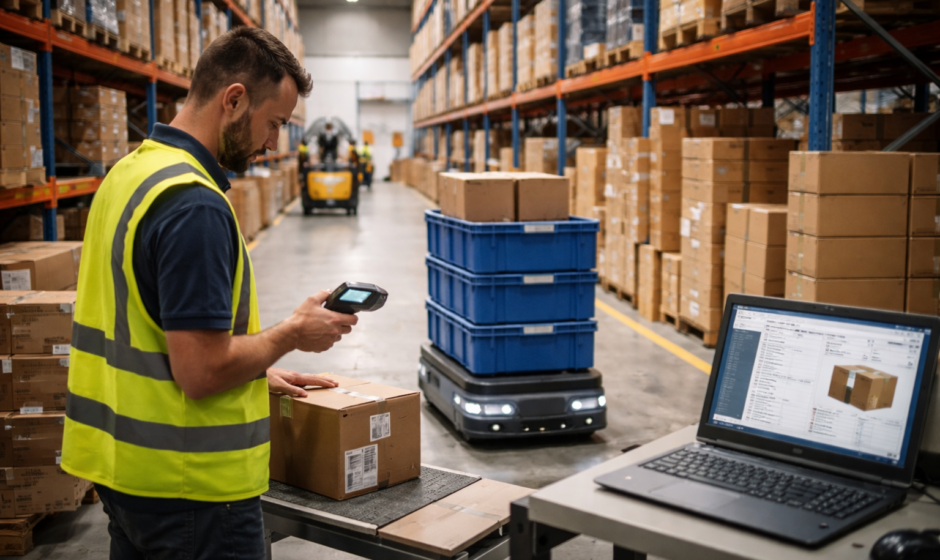

The massive growth of e-commerce has fundamentally changed how supply chains operate. Facilities face mounting pressure to fulfill orders faster and more accurately than ever before. To meet this rising demand, many operators are turning to AI in warehouse automation. These advanced systems promise to revolutionize how goods are stored, picked, and shipped.
At the core of this transformation is data. Machine learning models and robotic systems require vast amounts of information to function correctly. Without a steady stream of high-quality data, even the most advanced algorithms will fail to deliver meaningful results.
While the promise of incredible efficiency draws companies toward automation, severe data challenges often slow down actual adoption. Understanding how to collect, manage, and leverage this information is the real key to unlocking the power of smart warehouses. This post explores the core components of warehouse AI, the hurdles companies face with data, and the massive opportunities waiting for those who get it right.
What is AI in Warehouse Automation?
AI in warehouse automation refers to the use of artificial intelligence to manage, optimize, and execute physical and digital tasks within a distribution center. These systems rely heavily on machine learning algorithms and real-time data to make autonomous decisions.
A few common examples include:
- Autonomous mobile robots (AMRs): These machines navigate warehouse floors independently to transport goods.
- AI-powered inventory management systems: Software that tracks stock levels and predicts when items need replenishing.
- Computer vision: Cameras equipped with AI to sort packages and perform automatic quality checks.
These tools do not simply follow pre-programmed paths. They use real-time data to adapt to changing environments, allowing operations to run continuously and efficiently.
Why Data is Critical for Warehouse AI
AI systems are only as smart as the information feeding them. They rely on high-quality, diverse datasets to understand their surroundings and make accurate decisions.
Warehouse automation typically uses three main types of data:
- Visual data: Images and videos captured from warehouse cameras to help machines “see” objects.
- Sensor data: Inputs from LiDAR, RFID tags, and IoT devices that track movement and location.
- Operational data: Historical records regarding inventory levels, order flow, and shipping times.
Machine learning models need a healthy mix of real-world data and synthetic data to train effectively. Real-world data captures the messy reality of a bustling facility. If this data is poor, incomplete, or inaccurate, the AI’s decision-making will suffer, leading to operational bottlenecks and expensive mistakes.
Key Data Challenges in Warehouse Automation
Implementing AI in a distribution center is rarely a smooth process. Operators must overcome several complex data hurdles.
Data Collection in Dynamic Environments
Warehouses are constantly shifting. Layouts change, inventory moves, and human workers walk through aisles unpredictably. Capturing diverse, real-world scenarios in such a dynamic setting is incredibly difficult. AI models must learn to navigate a space that looks different every single day.
Data Annotation & Labeling Complexity
Before an AI model can recognize a pallet or a human worker, developers must feed it labeled images. This requires precise data annotation. Labeling thousands of images of boxes, forklifts, and shelving units is a highly time-consuming and expensive process.
Handling Edge Cases
An edge case is a rare scenario that an AI system struggles to process. This might include unusually shaped packaging, damaged goods leaking onto the floor, or unexpected obstacles blocking an aisle. Because these events happen infrequently, the AI lacks the data needed to learn how to handle them properly.
Data Quality & Consistency Issues
Incomplete, noisy, or biased datasets directly impact model reliability. If a camera lens is dirty, the visual data becomes flawed. If an RFID scanner misreads a tag, the operational data becomes inaccurate. Maintaining perfect consistency across a massive facility is a constant battle.
Scalability of Data Pipelines
As a warehouse expands, its data volume grows exponentially. Facilities must build scalable data pipelines to handle this influx. Machine learning models also require continuous data updates and retraining to remain effective as the business scales.
Opportunities Enabled by Better Data Strategies
Overcoming these data challenges unlocks incredible potential for logistics companies.
Improved Operational Efficiency
With accurate data, AI systems dramatically speed up picking, packing, and sorting processes. AMRs find the fastest routes, and automated arms sort packages with precision. This leads to reduced manual errors and higher overall throughput.
Enhanced Safety with AI Vision Systems
Warehouses are inherently dangerous places. AI vision systems use real-time visual data to detect human presence in restricted zones and identify potential hazards. This helps prevent accidents before they occur, keeping workers safe.
Predictive Analytics & Demand Forecasting
By analyzing historical operational data, AI can forecast future demand. This AI-driven inventory optimization ensures facilities keep the right amount of stock on hand, significantly reducing the risks of both stockouts and overstocking.
Scalable Automation Across Warehouses
When a company perfects its data strategy in one facility, it can replicate that success. Standardized datasets enable businesses to deploy AI systems faster across multiple locations, scaling their automation efforts efficiently.
Integration with Robotics & IoT
Better data allows for seamless communication between machines. When IoT sensors and robotics share high-quality information, they can make collective, real-time decisions that keep the entire supply chain moving smoothly.
Best Practices to Overcome Data Challenges
To harness the full power of AI, companies must adopt strong data management practices.
First, invest in high-quality data collection strategies. Ensure cameras and sensors are properly positioned and maintained. Second, use hybrid datasets. Combining real-world information with synthetic data helps models learn how to handle rare edge cases.
Additionally, consider outsourcing data annotation to specialized teams to ensure scalability and accuracy. You must also continuously monitor and update your datasets to reflect the ever-changing warehouse environment. Finally, implement robust data governance frameworks to maintain consistency and security across your entire operation.
Future Trends in AI for Warehouse Automation
The technology powering smart warehouses is advancing rapidly. We are seeing a rise in multimodal AI systems that process visual, text, and sensor data simultaneously for better decision-making.
Facilities will also increase their use of digital twins—virtual replicas of the physical warehouse used to test new layouts and workflows. Additionally, self-learning warehouse systems will require less manual retraining. Finally, expect a greater reliance on edge AI, which processes data directly on the robots and cameras for lightning-fast, real-time reactions.
The Future of Smart Warehouses
AI in warehouse automation depends entirely on data quality. While operators face significant challenges regarding data collection, labeling, and edge cases, these issues are solvable with the right strategies.
Companies that invest heavily in their data infrastructure today will gain a massive competitive edge tomorrow. To prepare for the future, start by auditing your current data collection methods and identifying gaps in your physical operations. Building a strong data foundation now is the first step toward a fully automated, highly efficient supply chain.
FAQs
Ans: – It is the use of artificial intelligence, machine learning, and robotics to perform operational tasks like sorting, moving inventory, and predicting demand without constant human intervention.
Ans: – Data is the information AI uses to learn and make decisions. High-quality visual, sensor, and operational data ensure the AI acts accurately and safely.
Ans: – The primary challenges include collecting data in constantly changing environments, the high cost of data labeling, handling rare edge cases, and maintaining data consistency.
Ans: – Companies can improve performance by investing in better data collection sensors, using hybrid datasets, continuously updating training data, and establishing strict data governance.
Ans: – Computer vision allows AI systems to “see” the warehouse. It is used for quality control, navigating robots, and detecting safety hazards.
Ans: – Yes. Synthetic data is artificially generated information that helps train AI models on rare edge cases that are difficult to capture in real life.